
Walk into any building that actually feels good to be in — a boutique hotel lobby, a well-designed office, a home that photographs beautifully even without a filter — and you'll notice something. It's rarely the furniture doing the heavy lifting. It's the light. Where it falls, how warm or cool it is, what it hides and what it reveals. That's the whole idea behind architectural lighting, and it's a field that has quietly become one of the most important disciplines in modern design.
This guide breaks down what architectural lighting actually is, why it matters more than most people realize, and what to look for when you're planning it for a home, office, retail space, or hospitality project — drawing on how a specialist manufacturer like Lumnati approaches both architectural lighting and interior lighting.
What Architectural Lighting Really Means
Architectural lighting isn't just "turning the lights on." It's the deliberate use of light and shadow to shape how a space is experienced. Light and shadow are, in a sense, inseparable twins — one doesn't mean much without the other, and their interplay is what gives a room depth, mood, and character.
A generic ceiling fixture illuminates a room. Architectural lighting designs it. It considers the architect's original intent, the interior designer's material palette, the way people will actually move through and use the space, and then translates all of that into a lighting plan that supports rather than fights the design. Done right, it's invisible in the sense that you don't notice individual fixtures — you just notice that the space feels right.
Why It Matters More Than Ever
A few things have converged to push architectural lighting into the spotlight (no pun intended):
LED technology matured. Modern LED fixtures are compact, efficient, and controllable in ways older lighting technology never was. That opened the door to features like adjustable color temperature, tunable beam angles, and fixtures small enough to disappear into a ceiling.
Design expectations rose. Clients — whether it's a homeowner or a retail chain — now expect spaces that feel considered, not just functional. Lighting is one of the most cost-effective ways to elevate a project without a full renovation.
Energy and lux efficiency became non-negotiable. Nobody wants light wasted where it isn't needed, and nobody wants under-lit areas where it's actually required. Getting the lux levels and efficacy right for each zone of a project isn't a nice-to-have anymore; it's baseline expectation.
The Core Building Blocks of a Good Lighting Plan
If you strip architectural lighting down to its essentials, a few components show up again and again across residential, commercial, retail, and hospitality projects:
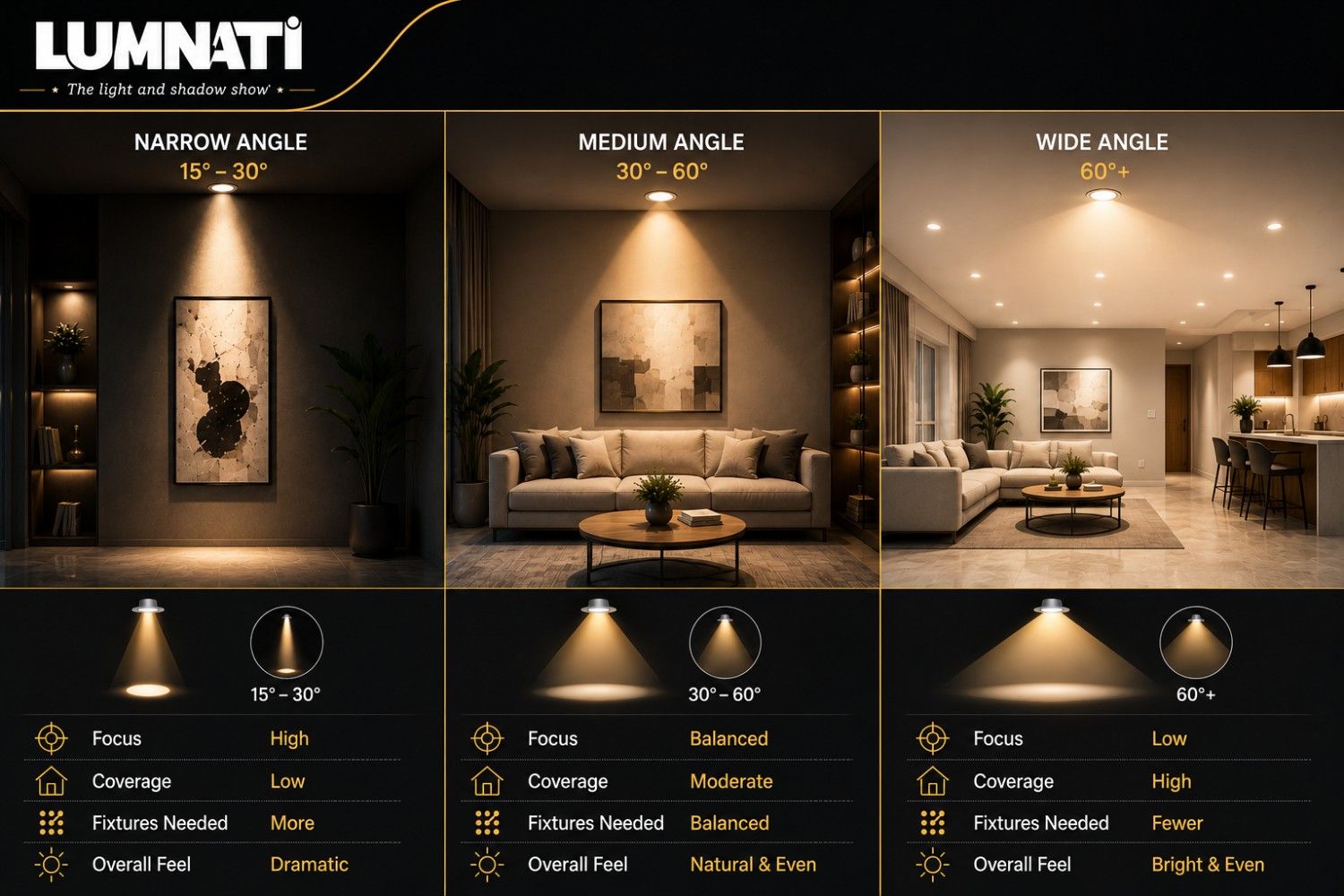
1. Downlights. The workhorses of ceiling lighting — recessed fixtures that deliver clean, even illumination without cluttering the ceiling plane. They're the go-to when the goal is a minimal, uncluttered look with reliable general lighting. Lumnati's Mars, Saturn, Aries, and Laser series fall into this category, each tuned for slightly different intensity and beam requirements.
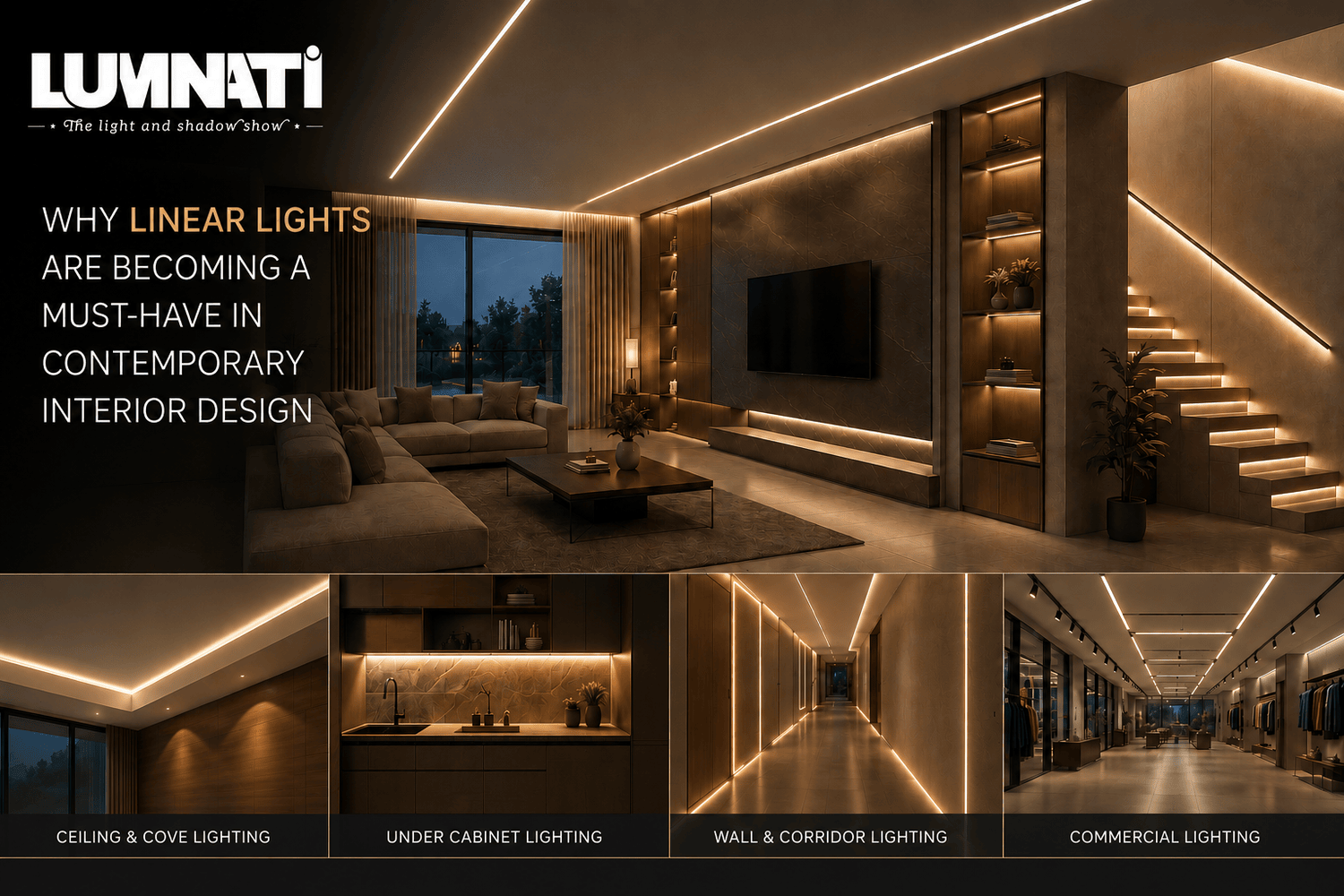
2. Linear lights. Long, continuous runs of light used to define edges, corridors, coves, or architectural lines. Linear fixtures are what give a space that seamless, almost sculptural quality — light that reads as a line rather than a point. Lumnati's Liny series is built around exactly this idea, along with dedicated low-glare linear options for demanding spaces like commercial parking structures.
3. Grazers and strips. These are about texture. Grazing light across a textured wall, a stone facade, or a feature surface brings out depth and detail that flat, frontal lighting would flatten out completely. It's a favorite technique for making statement walls actually feel like statements, and it's the focus of Lumnati's Grazer And Strip series.
4. Magnetic track lighting. Flexible, repositionable, and increasingly popular in retail and gallery-style spaces where lighting needs change as merchandising or displays change. A magnetic track system lets you redirect light exactly where attention needs to go, without rewiring anything — Lumnati's Galaxy series is one example built for this kind of flexibility.
Each of these categories exists because different surfaces and different intents call for different tools. A retail display wants punch and directionality. A residential living room wants warmth and softness. A commercial lobby wants scale and consistency. The fixture family should follow the goal, not the other way around — and this is really where architectural lighting and interior lighting overlap and start working together, since the structural fixtures need to sit comfortably alongside furniture, finishes, and decor rather than compete with them.
What Separates a Good Fixture from a Great One
Not all LED fixtures are created equal, and this is where a lot of projects quietly go wrong. A few things worth paying attention to:
- Precise beam control. Being able to redirect light exactly where it's needed — rather than letting it spill everywhere — is what separates a considered lighting plan from a generic one. This is where beam angle, color rendering, and light intensity all need to be customizable to the specific space and project.
- Accurate lux level planning. Different zones of a building need different amounts of light, and getting this wrong either wastes energy or leaves a space feeling dim and uninspired. A proper lighting layout maps lux requirements zone by zone before a single fixture goes in.
- Manufacturing quality and longevity. Everything from the base materials to the surface finishing affects how long a fixture lasts and how it performs years down the line — not just on day one.
- Real technical support. Lighting fixtures are technical products, and when something needs troubleshooting or a design needs reworking, having a responsive support and design team available makes a measurable difference to how smoothly a project runs.
From Concept to Installation: How the Process Should Work
A serious architectural lighting project typically moves through a few clear stages:
Design translation. The architect or interior designer's intent gets translated into a comprehensive plotting layout — essentially a precise map of where every fixture goes and why, so the contracting team on-site has a clear, executable drawing to follow.
On-site marking supervision. Plans on paper and reality don't always line up perfectly. This is why supervising the physical marking at the project site matters — it makes sure what's on the drawing board actually gets replicated on the ceiling and walls, not just approximated.
Lux level layout and calibration. Before final installation, lux levels are checked and adjusted so that each area — whether it's a reception desk, a retail aisle, or a living room — gets exactly the light quantity it needs, no more and no less.
Ongoing support. Good lighting partners don't disappear after the invoice is paid. Continued customer and technical support is part of what makes a fixture investment hold up over years of use — it's a philosophy Lumnati builds directly into its process, with design, support, and technical teams all reachable well after installation.
Choosing the Right Solution for Different Spaces
Homes and villas benefit most from a layered approach — general downlights for baseline illumination, linear or cove lighting to define architectural features, and grazing techniques on textured walls or art to add warmth and depth without overdoing it.
Retail outlets need lighting that does double duty: guiding customer attention toward products while keeping the overall space inviting. Magnetic track systems are particularly useful here because displays and merchandising change far more often than the ceiling does.
Commercial complexes and offices lean heavily on consistency, efficiency, and glare control — especially in spaces like parking structures or open-plan offices where low-glare linear lighting keeps things comfortable over long hours.
Hospitality spaces often want lighting to do the emotional work — creating ambience, warmth, and a sense of occasion, which usually means combining several fixture types rather than relying on just one.
Innovation Is Still Accelerating
What makes this field genuinely exciting right now is that it's not standing still. In-house R&D, dedicated manufacturing facilities, and application-based research are what let lighting companies keep pace with — and often get ahead of — changing design trends, rather than just reacting to them. Lumnati is a good example of this in practice: its in-house manufacturing and technical R&D team support a catalog of over 3,000 products, which only makes sense because every project genuinely does have different lighting needs, and a one-size-fits-all fixture rarely satisfies a serious design brief.
Final Thoughts
Architectural lighting sits at an interesting intersection of engineering and art. It needs the precision of lux calculations and beam angle specs, and it needs the sensibility to know when a wall deserves to be grazed instead of flooded, or when a corridor needs a clean linear line instead of a row of downlights. Get it right, and people rarely notice the lighting itself — they just notice that the space feels exactly the way it should. Get it wrong, and no amount of good furniture or paint color can fully compensate.
Whether you're planning a single room or a full commercial rollout, the underlying principle stays the same — one Lumnati holds to closely: no lumen of light should be wasted, and every fixture should earn its place in the design.
Frequently Asked Questions
1. What's the difference between architectural lighting and interior lighting? Architectural lighting is built into the structure of a space — downlights, coves, facade grazing — while interior lighting is the broader mix that includes decorative and furniture-based fixtures too. The two are usually planned together for a cohesive look.
2. How do I decide which fixtures I actually need for my space? Start with function, not fixtures. Living rooms want soft, layered light; retail floors want directional light; offices want even, glare-free coverage. The right fixture mix follows from there.
3. Why do lux levels matter so much in a lighting plan? Lux measures how much light actually hits a surface. Too low feels dim, too high wastes energy and causes glare — so lux is mapped zone by zone before installation.
4. Can architectural lighting be customized for a specific project? Yes. Beam angle, color rendering, and intensity can all be tailored to the space, especially for feature walls, facades, or retail displays.
5. Is LED architectural lighting more expensive than traditional lighting? Upfront cost can be higher, but lower energy use and longer fixture life usually make LED more cost-effective over time.
6. Do I need a professional lighting designer, or can I plan this myself? For one room, DIY can work. For larger or commercial projects, a professional team helps get plotting, lux calculations, and site supervision right.
1786536088.jpeg)