
Standing in a showroom trying to pick downlights, most people focus on wattage or finish and completely skip the one spec that actually decides how the room will feel: beam angle. Get this wrong and a beautifully finished ceiling still ends up with awkward hot spots or a flat, shadowless glare. Understanding the difference between narrow, medium angle downlights, and wide beam options is really the first step to lighting a space the way it deserves to be lit.
Here's a breakdown of how each angle behaves, where it fits, and how to decide which one your space actually needs.
What Beam Angle Actually Means
Beam angle is the width of the cone of light that comes out of a downlight, measured in degrees. A smaller number means a tighter, more concentrated beam. A larger number means the light fans out over a broader area. Same fixture, same wattage, completely different feel in the room depending on this one number.
It's easy to underestimate how much this changes a space. Two identical downlights with different beam angles, one at 24° and one at 120°, will light a room in almost opposite ways: one creates a dramatic pool of light on a single point, the other washes the whole ceiling evenly.
Narrow Angle Downlights
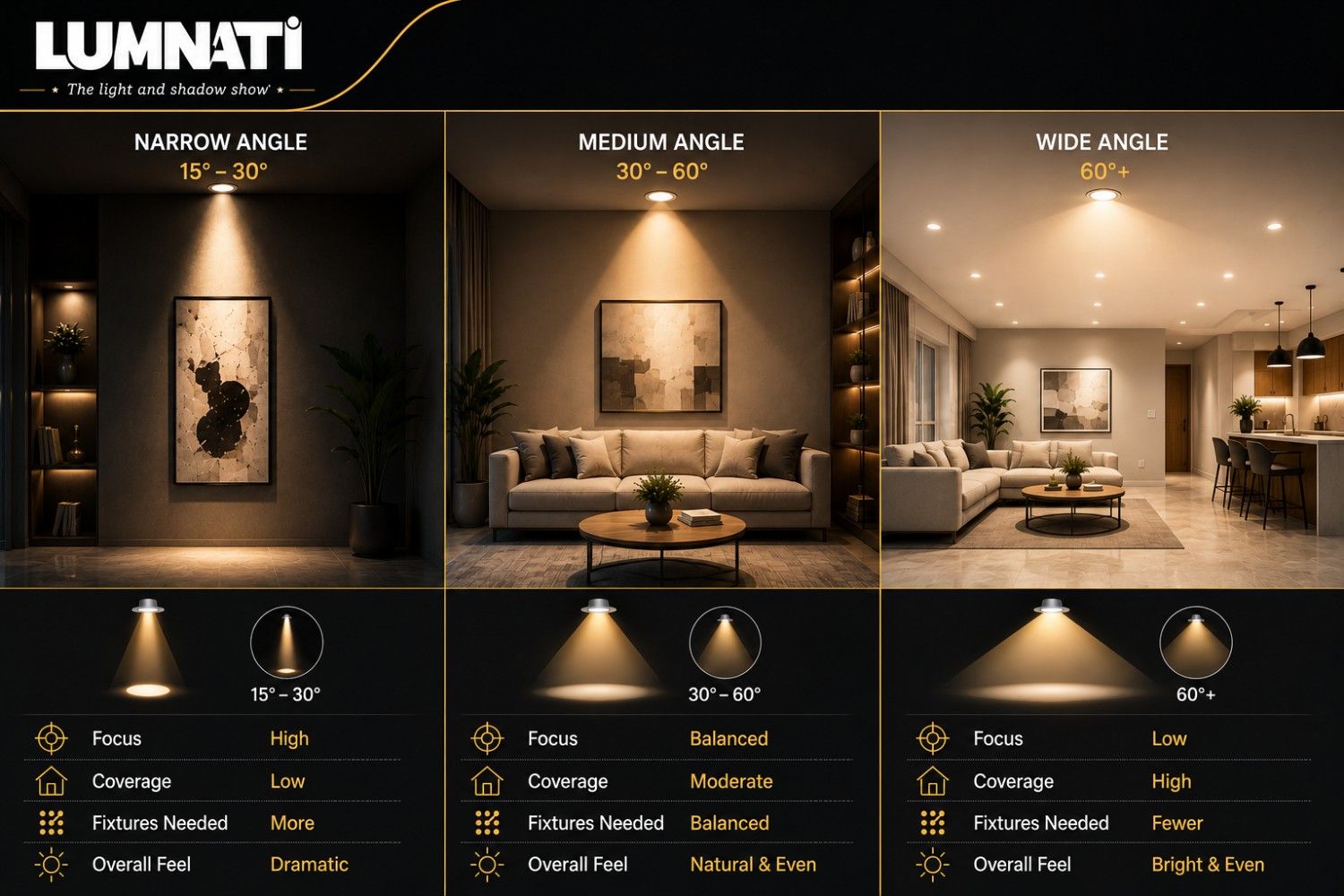
Narrow beam downlights typically sit somewhere between 15° and 30°. They throw a tight, focused circle of light, which makes them ideal for:
-
Highlighting artwork or a feature wall
-
Drawing attention to a product display or counter
-
Creating drama and contrast in a room, rather than flat, even brightness
The trade-off is coverage. A single narrow downlight only lights a small patch of floor or wall, so you'll need more fixtures to cover an entire room, which can push up both fixture and installation cost.
Medium Angle Downlights
This is where most general living spaces land. Medium beam angle downlight options usually fall between 30° and 60°, and they strike a balance between focus and spread. You get enough concentration to define a space without the harshness of a narrow spotlight, and enough coverage that you don't need a fixture every few feet.
Medium angle downlights work well in living rooms, bedrooms, hallways, and retail aisles, essentially anywhere you want the room to feel evenly lit but not flat. If you're unsure which angle to pick for a fairly standard room, medium is usually the safer starting point.
Wide Angle Downlights
Wide beam downlights, typically 60° and above, spread light generously across a large area. They're the go-to choice for:
-
General ambient lighting in open-plan spaces
-
Kitchens, offices, and commercial floors where even, shadow-free light matters more than drama
-
Ceilings where fewer fixtures need to cover a large surface
The downside is that wide beams can feel a little flat or characterless if used everywhere, without any narrow or medium fixtures to add contrast and depth.
Narrow vs Medium vs Wide Beam Angle: A Quick Comparison
|
Factor |
Narrow (15°–30°) |
Medium (30°–60°) |
Wide (60°+) |
|
Best for |
Accent, drama, highlighting |
General living spaces, balanced light |
Ambient, large open areas |
|
Coverage per fixture |
Low |
Moderate |
High |
|
Fixtures needed per room |
More |
Balanced |
Fewer |
|
Feel |
Focused, dramatic |
Even, natural |
Flat, uniform |
Thinking about it as narrow vs medium vs wide beam angle rather than picking a single "best" option usually gives the most realistic view, because most well-lit spaces actually combine all three: wide or medium for general ambience, and narrow for accents where it counts.
How to Actually Choose
-
Start with the room's purpose. A retail counter and a living room ceiling have very different needs even if they're the same size.
-
Decide what you want to draw attention to, if anything. If nothing needs highlighting, medium or wide will usually serve you better than narrow.
-
Think about ceiling height. Higher ceilings often need slightly wider beams to avoid overly concentrated pools of light on the floor.
-
Mix angles where it makes sense. A room lit entirely with one beam angle rarely feels as good as one that layers ambient, task, and accent lighting together.
-
Buy from a source that can actually explain the trade-offs, not just sell you a wattage number.
This is exactly where working with an established LED downlight supplier India businesses trust makes a real difference. LUMNATI's in-house manufacturing and design team help match beam angle, lux level, and fixture placement to the actual room, not just a generic spec sheet. Whether the project calls for tight accent lighting or broad, even coverage, having someone who understands how these angles behave in real spaces saves a lot of trial and error.
The Bottom Line
There isn't a single "correct" beam angle. Narrow, medium, and wide downlights each do a specific job well, and most good lighting plans use a mix of all three rather than betting everything on one. If you're only choosing one type for a fairly standard room, medium angle downlights are usually the safest, most versatile starting point, but the real skill lies in knowing when to break from that default.
FAQs
What is the standard downlight angle?
There's no single universal standard, but medium beam angles, roughly 30° to 60°, are the most commonly used for general residential and commercial spaces because they balance coverage and focus reasonably well.
What is the best type of downlight?
It depends on the space. Narrow angles suit accent lighting, medium angles suit general living areas, and wide angles suit large open or ambient spaces. The "best" choice is the one matched to the room's actual function.
What does 120 degree beam angle mean?
A 120° beam angle means the light spreads out very widely from the fixture, close to the widest end of the wide-angle category. It's used for broad, even, ambient lighting rather than focused highlighting.
Which brand downlight is best?
This depends on your project's specific requirements, such as lux level, color rendering, and beam angle needed. Suppliers with in-house manufacturing and design support, like LUMNATI, tend to offer more accurate, project-specific recommendations than off-the-shelf retail options.
What is the difference between 60 and 120 LED lights?
A 60° beam is a medium angle that creates a focused but reasonably sized pool of light, better for defining a space. A 120° beam spreads much wider and flatter, better suited for general, even ambient lighting across a larger area.
Which type of angle is 120 degrees?
120° falls into the wide beam angle category, used for broad, ambient coverage rather than focused or accent lighting.
1786536088.jpeg)