
The right anti-glare downlight has a deep recessed optic, a beam angle that suits your ceiling height, a CRI of 90 or higher, and a color temperature that fits the room. Get those four right and the light feels calm instead of tiring.
You walk into a room, glance up, and the ceiling looks like a field of tiny, blinding dots. Or you sit down to work and a hard spot of light bounces off your screen all afternoon. That's glare, and it's usually a fixture problem, not a bulb problem.
At Lumnati, we design and manufacture architectural lighting, and glare comes up in almost every project conversation. This guide walks you through how to choose, one step at a time, without the jargon.
What Makes a Downlight "Anti-Glare"?
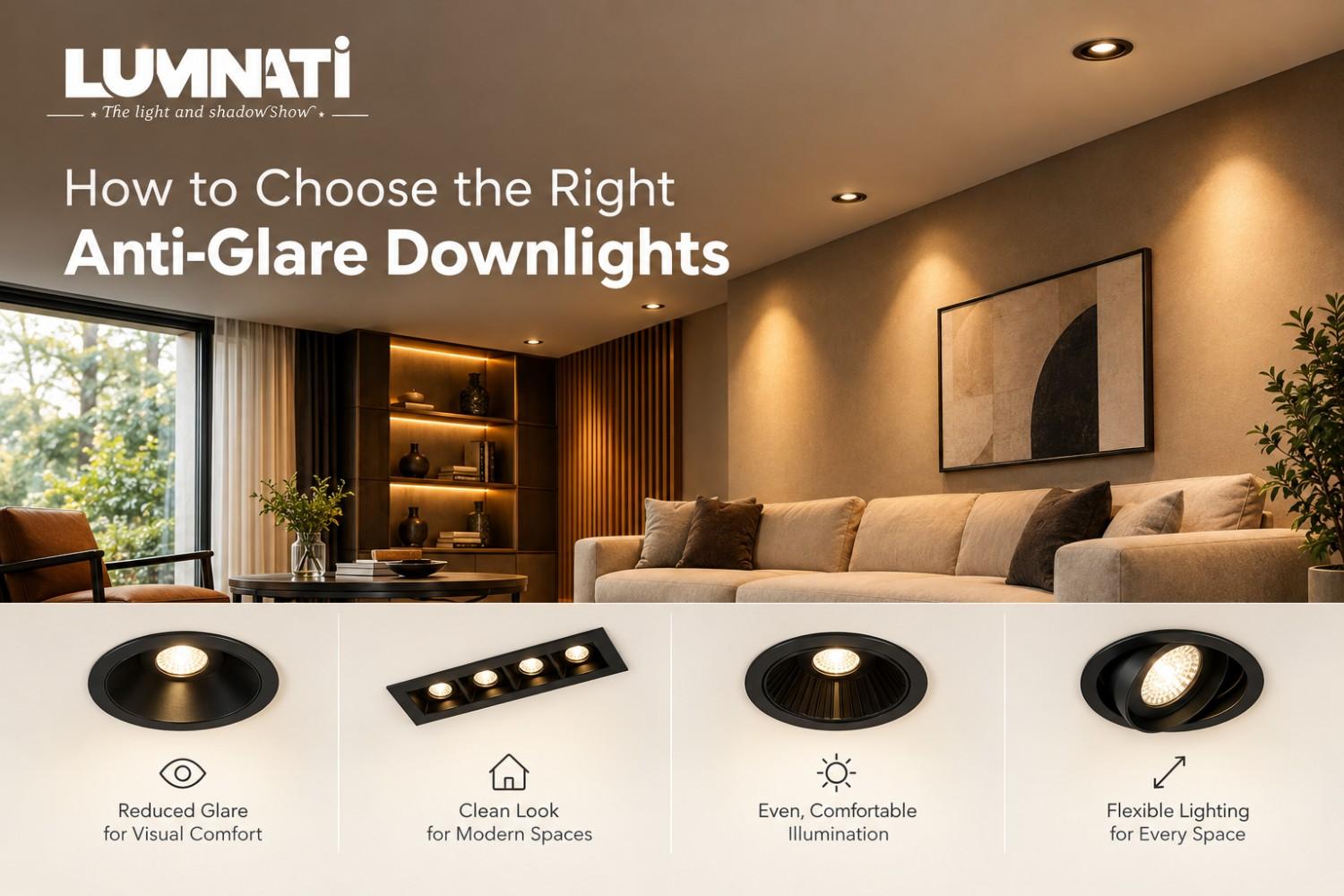
Glare happens when your eyes catch the bright light source directly instead of the light it casts. A basic downlight puts the LED right at the front of the fitting, so you see it from almost any angle. An anti-glare downlight sets the LED deeper inside the housing and uses a shielded optic, a reflector or a honeycomb louver to hide it.
The result is that light falls where you need it, on the floor, the table or the wall, while the source stays out of your direct line of sight. That's the core idea behind our Anti Glare Technical Downlights, and it's the first thing worth checking on any spec sheet.
Step 1: Check the Glare Control
Three things tell you how well a downlight controls glare.
UGR rating
UGR stands for Unified Glare Rating. Lower numbers mean less discomfort. For offices, classrooms and other work areas, aim for UGR 19 or below. For corridors and lobbies you can be a little more relaxed, but lower is still better.
Recess depth
The deeper the LED sits inside the fitting, the harder it is to see from the side. This matters most in rooms where people walk in at an angle, like hotel lobbies and open-plan offices.
Cut-off angle
This is the angle at which the light source stops being visible. A cut-off angle of 30 degrees or more is a good sign of a comfortable fitting.
Step 2: Pick the Right Beam Angle
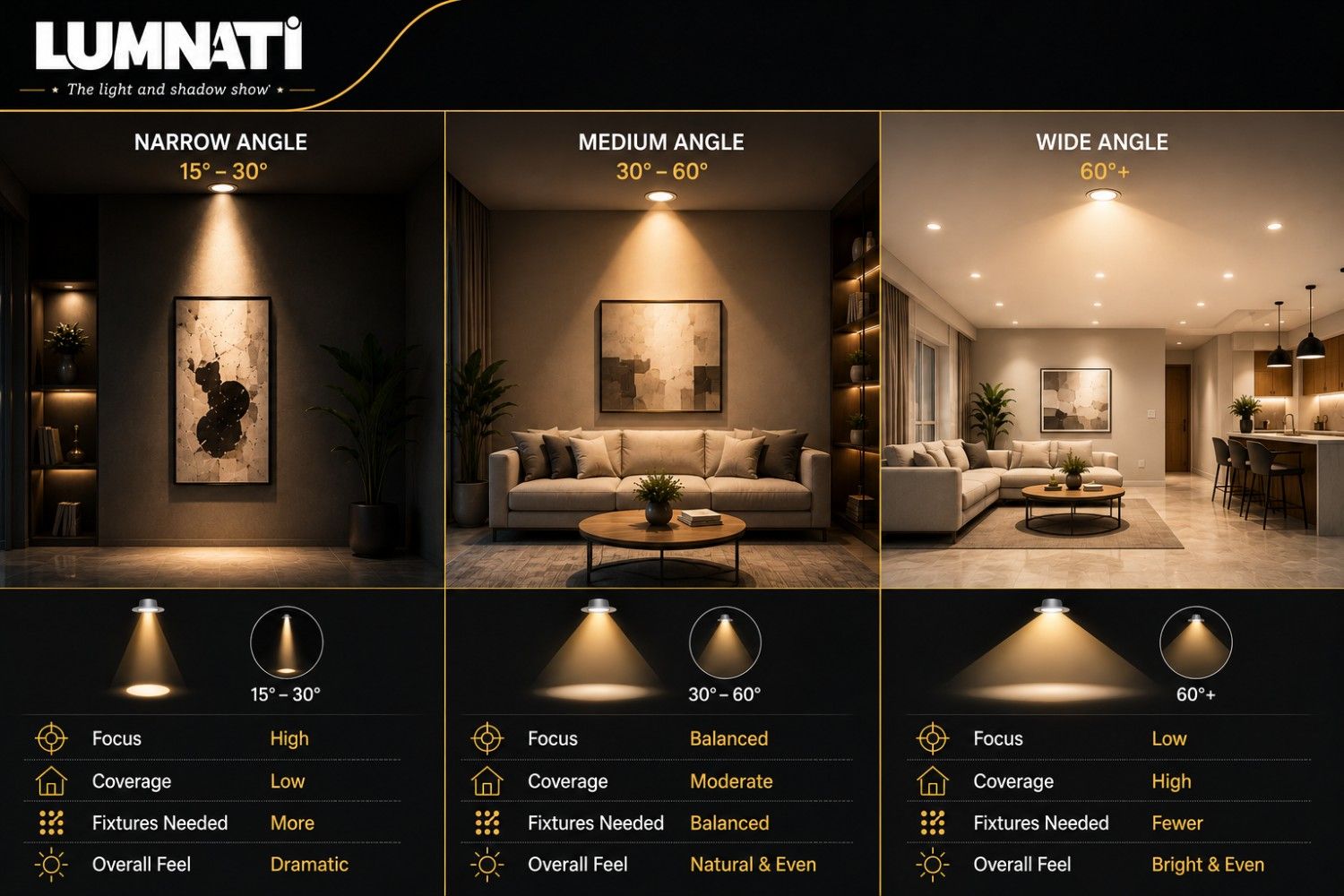
Beam angle decides how wide the light spreads, and it changes how a space feels. Narrow beams (about 10 to 24 degrees) suit accents on art and shelves, medium beams (25 to 40) suit kitchens and dining tables, and wide beams (40 and above) suit general lighting.
A quick example. From a 2.7 m ceiling, a 24-degree beam makes a pool of light about 1.1 m wide on the floor. A 60-degree beam makes one about 3.1 m wide. That's why Wide Angle Downlights are the usual choice for general lighting: they overlap softly, avoid hot spots and need fewer fittings to cover a room evenly.
Narrow beams create drama, but they can feel harsh as your only light source.
Step 3: Don't Skip Color Quality (CRI)
CRI, or Color Rendering Index, measures how faithfully a light shows real colors on a scale of 0 to 100. A low-CRI light can make food look dull, skin look gray and fabrics look flat.
For homes, restaurants, boutiques and showrooms, we recommend High CRI downlights rated 90 or above. For purely functional spaces like storage rooms or parking areas, a lower CRI is usually fine. If you want to go deeper, look at the R9 value too, which shows how well a light renders deep reds. It matters a lot in skin tones, wood and food.
Step 4: Choose the Right Brightness and Color Temperature
Brightness
Think in lux, the amount of light that lands on a surface, rather than watts. A living room is comfortable at around 100 to 200 lux. A kitchen or an office desk may need 300 to 500 lux. More isn't always better, and over-lighting is one of the quiet causes of glare.
Color temperature
-
2700K to 3000K (warm): bedrooms, living rooms, restaurants, hotels.
-
3500K to 4000K (neutral): kitchens, retail, hospitality corridors.
-
4000K to 5000K (cool): offices, studios, workshops.
Dimming
If a room has more than one job, such as a lounge used for both movie nights and family dinners, choose dimmable fittings. Lower output at night is the easiest glare fix there is.
Step 5: Match the Downlight to the Room
Living rooms and bedrooms. Use wide or medium beams with a warm tone and deep recess. Keep lights away from directly above the bed or sofa headrest, since you'll be looking straight up at them.
Kitchens. Go for medium beams, neutral white and good CRI so food and counters look right. Place lights over work zones, not in a rigid grid.
Offices. Low UGR matters most here. Choose a shielded, wide beam and position fittings beside screens, not directly behind the line of sight.
Retail and hospitality. Mix narrow beams for displays with wide, soft general lighting. High CRI is non-negotiable for products and food.
Common Mistakes to Avoid
-
Choosing only by lumens. A very bright fitting with poor glare control is worse than a modest one with a good optic.
-
Spacing lights too close. You get bright dots and shadows instead of an even wash.
-
Ignoring ceiling height. A beam that works at 2.4 m may feel too tight or too sharp at 4 m.
-
Mixing color temperatures. Use the same tone in connected spaces so they feel consistent.
-
Skipping a layout. Planning on paper saves expensive changes after installation.
Explore Lumnati's Downlight Range
Our indoor downlights collection is built for precise, comfortable illumination in homes, offices, retail and hospitality spaces. You can browse these series:
Because we manufacture in-house, we can adjust light intensity, color rendering and beam angle to suit your space. Our team also prepares plotting and lux level layouts, so what you see on the drawing is what ends up on the ceiling. You can read more about Lumnati and how we work.
A Quick Checklist Before You Buy
-
Is the UGR suitable for how the room is used?
-
Is the LED recessed or shielded from side views?
-
Does the beam angle fit your ceiling height?
-
Is the CRI 90 or higher where color matters?
-
Is the color temperature right for the mood?
-
Can it dim, if the room needs flexibility?
-
Do you have a layout showing spacing and lux levels?
Frequently Asked Questions
What are anti-glare downlights?
They are recessed ceiling lights that hide the light source from normal viewing angles. Lumnati's Anti Glare Technical Downlights are built around this idea.
What UGR value is good for downlights?
For offices and work areas, aim for UGR 19 or lower. Lumnati can help you match fixtures to the UGR your space needs.
Is a high CRI really necessary for downlights?
For homes, retail and hospitality, yes. A CRI of 90 or above keeps colors natural, and Lumnati offers High CRI downlights for this reason.
Which beam angle is best for a living room?
Medium to wide angles, roughly 36 to 60 degrees, give soft, even coverage. Lumnati's Wide Angle Downlights suit most living rooms.
Can Lumnati customize downlights for a project?
Yes. Lumnati can adjust light intensity, color rendering and beam angle to suit your project and space.
How many downlights do I need per room?
It depends on room size, ceiling height and the lux level you want. Lumnati's design team can prepare a lux level layout for you.
Final Thoughts
Choosing anti-glare downlights isn't about finding the brightest fitting. It's about comfort: a shielded source, a beam that fits the room, honest color and a tone that suits the mood. Work through the steps above and you'll avoid most of the problems people regret after installation.
Need help choosing?
Browse our downlights collection or talk to the Lumnati team about your project. We're happy to suggest the right fittings and layout.
1786536088.jpeg)